The Advent Fast is Kicking My A**

I was raised Southern Baptist, among a congregation to whom the idea of fasting was like sackcloth and ashes — we read about it in the Bible, but it was a superannuated idea; no one actually did it. Not when there were casseroles to eat.

In my twenties, when I moved to New Orleans and began my Catholic dabblings, I also began to practice Lenten fasting, and found it to be a highly rewarding tradition. Of course, not belonging to any specific institution gave me the freedom to put my own spin on it. One year I gave up cutlery in favor of eating with my hands. Another year I gave up wearing makeup. When I found out that the Orthodox church has fasts galore, I was psyched.

But the rules of the Orthodox fasts are complicated and intense, exercising your brain as much as your willpower. I spent the first few days of the fast eating nothing but bread and carrot sticks. And then I realized I was going to get rickets or at least the flu if I didn’t figure out something else. I spent a bunch of time reading Orthodox lifestyle blogs only to discover that not everyone is on the same page about the fast rules. The question seems to be one of literalism versus the spirit of the fast.

This quote from the Orthodox Church in America website, explains part of the reason for the fast. (You can read the full entry here.)

By fasting, we ‘shift our focus’ from ourselves to others, spending less time worrying about what to eat, when to eat, how much to eat, and so on in order to use our time in increased prayer and caring for the poor. We learn through fasting that we can gain control over things which we sometimes allow to control us—and for many people, food is a controlling factor.

The problem for me is that the Advent Fast has shifted an extraordinary amount of my focus to my diet. I’m not a person who especially cares about food. I try to eat somewhat healthily, but I work at night, and so I wind up eating things that can be thawed quickly in an oven. Cooking isn’t really my favorite thing anyway. I’ve often wished I could take all my meals in pill form.

Though I am also accompanying my fast with prayer and scripture reading, I don’t feel liberated from food in the sense that I think I’m supposed to. If anything, I feel more stressed out about it because, unlike the women who write the Orthodox mom lifestyle blogs, I don’t spend my days dreaming up and preparing meals for my family. My husband is neither Orthodox nor fasting, so when I do cook, two separate meals must be prepared because I’d feel bad about giving him a bowl of salted quinoa and an avocado for supper.

As much as I want to feel solidarity with my new church, I’m sort of wondering if I should abandon the fast, and go make a batch of Christmas cookies already.
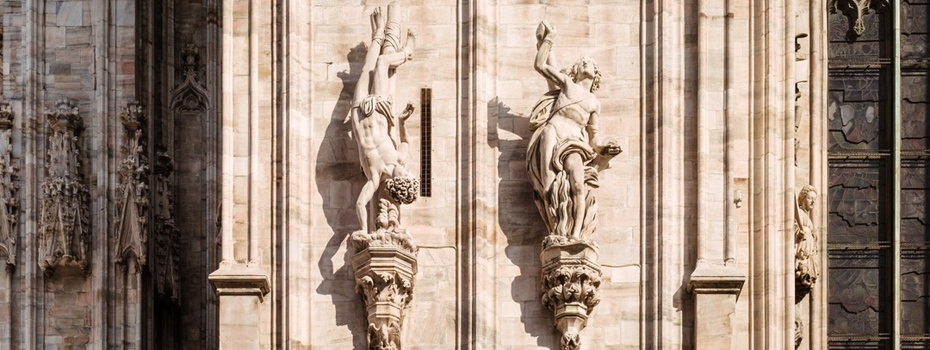
 

The Saints Come Marching In

For years, I’ve collected religious iconography. Moist-eyed apostles festoon my walls; my jewelry box overflows with rosaries and holy medals. This summer I even made a 500-mile pilgrimage on foot to the relics of St. James, and have a certificate verifying—in Latin—the completion of my journey.

I began collecting saints my during a brief brief romance with vodou, and I’d been introduced to many of them syncretism with the lwa. My relationship with vodou was tumultuous. When it was over, all that remained was Mary. Whenever I was inwardly freaking about something, without fail I would see an image of the Virgin — whether it was a statue in someone’s yard or a tattoo on somebody’s arm — I felt like She was looking out for me. Later, when I began to pray to her, I had an experience that I can only describe as an awareness of God’s awareness of me.

But when it comes to the other saints, I’m affected more by their stories than their presence. Joan of Arc is one of my heroes. I also like to think about St. Anthony, hanging out in his mountain crevasse, trying not to be bored. Or St. Elijah hearing God’s voice in the gentle breeze. As a writer, I’m compelled by stories. Give me five minutes on a train or an airplane and I’ve made up a story about everyone around me. I love taking walks through the cemetery in my neighborhood and trying to piece together stories based on the headstones.

But ultimately, with the exception of Mary, that’s kind of how the saints seem to me — like dead people.

I don’t want to feel this way. I want to be the kind of person who believes in the saints and has a whole skyfull of magical pals, and for whom the world is mysterious and flickery and smells like wax and old wood and who doesn’t care if people think she’s crazy. The truth is, my inability to believe that I can actually talk to the saints has nothing to do with what other people think, because in the end, what I pray, and to whom, is private. Nevertheless, I feel … weird about it.

This summer on the pilgrimage, I talked to St. James a lot. I was on the way to his relics, so I figured I might as well introduce myself. I talked to him about all kinds of stuff, but mostly I prayed for a guy who had a brain tumor. Because St. James was decapitated, I thought he might be especially sensitive to matters of heads.

The priest at my church says we pray for the intercession of the saints the same way we’d ask a friend to pray for us. The saints aren’t dead, he tells me, their spirits are alive with God. Which is nice, and kind of makes sense. But when I got to Santiago, where James’ relics are, I found out that they were mixed together with the bones of two other guys I’d never heard of, and — I don’t know. Something about it just made me mad, like it had been a sham. I know James can’t help it if they snuck some other guys into his box, but it felt like trickery. I prayed at the relics anyway, because I’d come all that way. But in the end, the pilgrimage had been the point, not the bones.

When I got home, I found out the guy with the brain tumor underwent surgery and is now doing fine. It doesn’t prove anything. But it gives me hope.


God is Capricious and So Am I

It’s 10:30 on a Sunday morning, and right now at the Orthodox church I’ve been attending, the bell is ringing. Just inside the front doors, the faithful are lighting thin yellow tapers and arranging them in a wooden tray filled with sand. They pause for a moment at this table of light and pray to the icons on the wall before crossing themselves. When they enter the sanctuary, music and incense pour from behind the doors, ancient and sweet.

But I’m not in church this morning. I’m at home smelling the mushroomy scent of rain and listening to the occasional moan of a freight train. I’m barefoot and wearing my favorite ratty shirt. I’m a little depressed.

If a new religion is like a new lover, then I suppose I’m at the phase of the relationship where one realizes the new lover isn’t perfect after all. Now I can’t remember why I thought it would be such a super idea to be exclusive.

Eastern Orthodoxy and I haven’t had a fight or anything. It’s just that at first it seemed so exotic with the incense and the Romanian priest and the sanctuary full of immigrants from all over the world. Last week, I even went to Saturday evening vespers for the first time, and it was so beautiful that I actually cried.

But at liturgy the next morning, it seemed like God had decided to sleep in. Maybe because every little kid in attendance had apparently been mainlining corn syrup—the church was filled with screeching, writhing, raisin-flinging spawn that seemed more like peltless beasts than people. Halfway through the service I started to get a headache, and I left feeling like I’d been stood up. It stung especially after the vespers service been so special—like Eastern Orthodoxy (or God) was having second thoughts about me.

I told my husband I was going to play hooky from church today, and explained about the liturgy where God had stood me up. “Christians are told all this stuff about how much God wants to have a ‘relationship’ with humanity, but then you can’t even count on Him to show up,” I said. “Maybe God is making overtures to me all the time and I’m too caught up in my own reality to see it, but it annoys me that when I’m actually making the effort, it’s still a total crapshoot.”

“Well, how much time during the week do you actually spend praying and stuff?” my husband asked. “Maybe you’re putting too much pressure on a certain day of the week.”

I glared at him. “Look,” I said. “My point is, God is . . . capricious.”

You’re capricious,” he said. “Your religious life has been very capricious.”

This made me laugh. He’s totally right.

But here is the nut of the problem for myself and anyone who has ever attempted to perceive God: the inescapable human tendency to “make God in our own image.” Consider the warmongering fundamentalists of every religious sect, ever. Consider the past week’s news headlines. If we can only perceive God as a function of ourselves, then what? It seems the best we can hope for is a few strange moments when our conceits are stripped away and we are left with raw wonder.

I suppose that in the end, I stayed home this morning out of instinct. I don’t want to get into the habit of thinking or behaving like there’s only one way to access God—precisely because I know God to be capricious, I know I must leave room for surprises. The Eastern Orthodox way of worshiping is so ritualistic, I worry that once the novelty has worn off, it will become rote and uninspired. Maybe this has already started to happen.

So today I look for God in the rain, and in Rachmaninov.


Going on a Date with the Orthodox Chuch

Recently I’ve been attending an Eastern Orthodox church. Those close to me are skeptical, doubtlessly thinking that I’ve entered another phase of religious dabbling. Maybe that’s all it is. I collect religious identities the way some people collect Hummel figurines. To wit: I was raised Southern Baptist, but I’ve also practiced voudou. I’ve been non-denominational, a wiccan manquée, and an atheist.

In the past few years, though, I’d resigned myself to the idea that a person’s experience of the Divine is a necessarily individual experience, and I gave up on church. Any time I’d had any kind of numinous experience, I’d been alone. When I thought back to many of my church experiences, I remembered a room full of people, not God. Usually, the people were distracting: kids fidgeted, adults had gingivitis, or wept openly. When I finally decided to give up on church it was a relief, and I was proud of the way I’d liberated myself from a cycle of disappointment.

At home on Sunday mornings, reading poetry or listening to podcasts, there were no crying babies, and the only bad breath was my own. It wasn’t always transcendent, but sometimes I’d read a line from Rumi and it would blow my mind. But often I was lonely. Sometimes I would have some new theory about the way things are—and I’d want to discuss it with somebody. But in my life there is a dearth of people with whom I can have metaphysical discussions.

I’m attracted to the Eastern Orthodox Church because it’s supposedly a spacious tradition, able to account for both the boundless mystery of God, and also man’s intellectual scrutiny.

But it’s liturgy that really sends me. The entire thing is sung! They swing this incense censer all over the place, and the censer has bells on it. There are candles everywhere. And the icons are those beautiful Byzantine kind with the pointy golden faces and the sad eyes, and there’s a lot of parading around and whooshing curtains. It’s dramatic—but also very solemn and mystical, so different from the evangelical church I attended several years ago, where the service was structured around the whims of the pastor, and where a rock band played and people waved their hands around in the air before and after the sermon.

My favorite part of the liturgy—and it doesn’t happen every time—is when this particular woman sings a mournful Arabic song during Holy Communion. Her voice is like a banner rippling in the hot desert wind. It makes me think of pomegranates and broken hearts and ashes, but when she finishes singing, she looks very matter-of-fact about the whole thing.

A new religion is like a new lover—you can be head-over-heels with what you think it is, when in actuality it’s pretty much the same as your ex. I know that right now, the allure is purely aesthetic. Eastern Orthodoxy and I have had some nice dates, but we haven’t really gone beyond the superficial — we haven’t had any deep discussions. Next month I’ll start  taking catechism classes, and get beyond the “bells and smells.”

This is the only way I can really discover what it means to be Orthodox. I have a huge list of questions. Some will be easy to answer (What is the wooden paddle and why do people kiss it?) and some will be more tricky (Why does the church exclude people from Communion? Why does the church exclude women from the clergy? What about gay people?). I plan to do a bit of blogging about it here.